

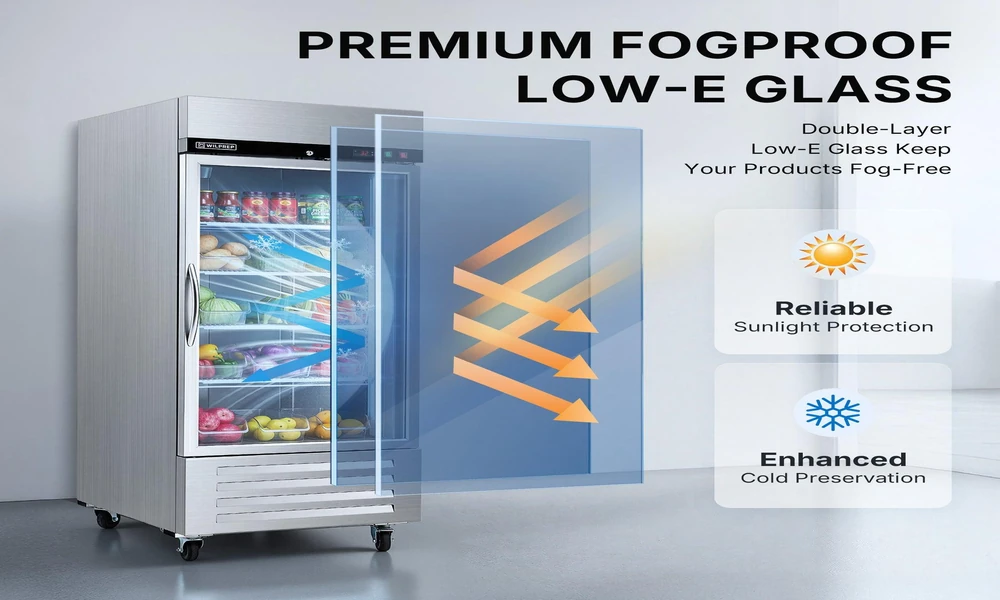
Most restaurant operators spend hours comparing compressor brands and cubic footage, then pick a door type in the last five minutes of the buying process. That ordering is backwards. The door is the single largest uncontrolled heat-transfer surface on a reach-in refrigerator, and the choice between glass and solid changes not only what the unit costs to run but also how staff interact with it during a rush. The two configurations are not interchangeable trim levels; they solve different operational problems. Understanding that distinction is the difference between a refrigeration purchase that pays for itself and one that quietly bleeds money through the utility meter for the next decade.
The Physics Is Simple: Glass Transfers Heat, Solid Doors Resist It
Glass door units carry a structural disadvantage that no amount of engineering fully erases: transparent panels have a lower insulating value than insulated solid panels, which means the compressor works harder to hold the same interior temperature. Industry energy benchmarks reflect this gap directly. Solid door commercial refrigerators are generally more efficient than glass door units of comparable volume, and ENERGY STAR program analysis has consistently treated solid and glass door categories under separate efficiency thresholds because the glass-door baseline is inherently more energy-intensive.
That does not make glass doors the wrong choice. It makes them the right choice only when visibility delivers a return that offsets the energy premium. In a front-of-house beverage merchandiser or a retail grab-and-go case, glass is the entire point: customers buy what they can see, and a solid door behind a retail counter suppresses impulse purchases. In a back-of-house prep kitchen, visibility delivers almost no revenue benefit, and a solid door reach-in refrigerator is the rational default: lower heat load, more stable interior temperature, fewer compressor cycles, and one less surface to clean and fingerprint during service.
Where the Cost Difference Actually Shows Up
Purchase price is the most visible difference, but not the most consequential one. Wilprep’s 54-inch double-door platform illustrates how the two configurations diverge in practice. The solid-door version lists at $2,599, while the glass-door version of the same 35.5 cubic-foot footprint lists at $2,999 – a $400 gap at the register. The more meaningful gap sits in the warranty structure. The glass-door model carries a 3-year parts-and-labor warranty plus a 5-year compressor warranty, while the solid-door configuration at that tier carries a 1-year parts-and-labor term with a 3-year compressor warranty. For an operator buying a back-of-house workhorse, the solid-door unit’s lower purchase price and simpler construction mean fewer failure points over a 12-to-16-hour daily duty cycle, even though its warranty paper is shorter.
The operating-cost picture narrows the gap further. Both configurations run on R290 refrigerant with a published coefficient of performance around 1.6 and an estimated annual energy cost in the 220 range at typical commercial usage. That figure is not hypothetical marketing copy: R290’s thermodynamic properties allow commercial reach-ins to hit efficiency ratios that legacy HFC refrigerants struggle to match, and the refrigerant is EPA-approved for commercial foodservice with no HFC phase-out exposure. For an operator choosing between door types, the relevant question is not “which unit is cheaper today” but “which unit’s total cost – purchase, energy, and service – matches how this particular cabinet will actually be used.” The commercial refrigerators and freezers catalog groups glass-door and solid-door configurations side by side by capacity tier, which makes that comparison possible without bouncing between vendor sites.
Matching the Door to the Workflow, Not the Catalog Photo
The practical rule most operators converge on is workflow-based. Front-of-house cases, beverage merchandisers, and any cabinet where customers or servers need to assess stock without breaking the temperature seal belong in glass. Back-of-house line storage, bulk ingredient reach-ins, and any cabinet that lives in a hot, high-traffic kitchen wall belong in solid. A café that stores milk and produce behind the counter for staff retrieval does not need a glass door; a convenience store selling bottled drinks does. A full-service restaurant running a 16-hour service day with constant line-cook access benefits from the solid door’s recovery profile; a bakery displaying cakes for walk-in customers does not.
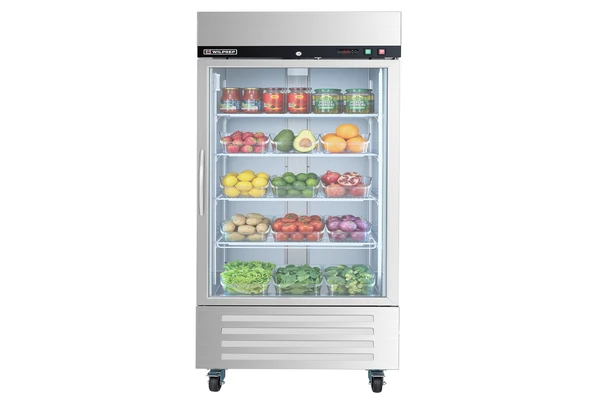
Wilprep’s lineup covers both sides of that divide without forcing an operator to switch suppliers mid-build. The Wilprep commercial refrigeration range includes glass-door merchandisers with LED ad-lighting for retail environments, solid-door reach-ins for back-of-house storage, and prep tables and undercounter units for station-level cold holding, all sharing the same UL and NSF certification baseline and the same R290 refrigerant architecture. That consistency matters at the point of specification: an operator building out a kitchen can size the cold-storage stack across categories without renegotiating certification terms or refrigerant compatibility with each purchase.
The Bottom Line: Specify the Door Before You Specify the Brand
The glass-versus-solid decision is a workflow decision disguised as a cosmetic one. Glass buys visibility at an energy cost that only pays back in customer-facing or high-retrieval settings. Solid buys thermal stability and simplicity at a visibility cost that only matters where someone actually needs to see inside. Operators who make that call explicitly – rather than defaulting to whichever unit photographs better in a catalog – end up with a refrigeration stack that matches the room it lives in, the staff who use it, and the utility bill it generates. The specification sheet should follow that decision, not lead it.
